
Website Speed and SEO: Why a Slow Site Is Costing You Customers
Slow website load times don't just frustrate visitors — they hurt your Google rankings too. Here's how speed and SEO are connected, and how to fix it.

CloudComets Team
Engineering & Design Studio
Published by CloudComets Team
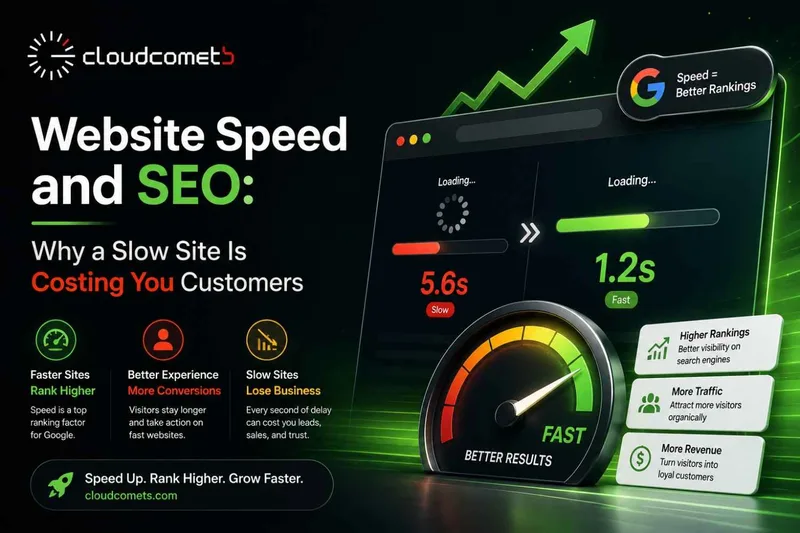
Speed Isn't a Technical Detail — It's a Revenue Issue Most business owners think of website speed as a minor technical concern, something for developers to worry about. In reality, page speed directly affects two things that matter enormously to any business: how many visitors stay long enough to buy, and how high you rank on Google.
How Speed Affects Visitor Behavior
Every additional second a page takes to load increases the chance a visitor leaves before it finishes. This is especially true on mobile, where visitors are often on the move, on unreliable connections, and have zero patience for a spinning loader. A slow homepage doesn't just lose that visit — it often loses that customer permanently, since most people won't try again.
How Speed Affects Google Rankings
Google has confirmed that page speed is a ranking factor, particularly through Core Web Vitals — metrics that measure loading performance, interactivity, and visual stability. A slow site can rank lower than a faster competitor even with similar content quality, simply because Google prioritizes a good user experience.
Common Causes of a Slow Website
- Unoptimized images — large image files are the single most common cause of slow load times
- Too many plugins or scripts — each one adds load time, especially poorly coded ones
- No caching — every visitor forces the server to rebuild the page from scratch
- Cheap or overloaded hosting — shared hosting under heavy load slows every site on it
- Bloated code — unused CSS and JavaScript that never got cleaned up after design changes
What Actually Fixes It
- Compressing and properly sizing every image before upload
- Enabling browser and server-side caching
- Minifying CSS and JavaScript files
- Using a content delivery network (CDN) for faster global load times
- Choosing hosting appropriate to your site's actual traffic and complexity
Speed Should Be Built In, Not Bolted On
The sites that perform best aren't the ones optimized after the fact — they're the ones built with performance in mind from the first line of code. Retrofitting speed onto a bloated site is possible, but it's almost always more work than building it right from the start.
A Quick Way to Check Where You Stand
Run your site through Google's PageSpeed Insights tool. If your mobile score is in the red or low yellow, visitors — and your rankings — are likely feeling it already.
In Summary
Building right from the start ensures long-term performance, security, and growth for your digital presence.
Related Articles

How to Get Your Business to Rank #1 on Google (Local SEO Guide)
A step-by-step local SEO guide to help your business rank higher on Google Maps and local search results — no agency jargon, just what actually works.

How Much Does It Cost to Build a Website in 2026?
A clear breakdown of what it actually costs to build a business website in 2026 — by site type, features, and what drives the price up or down.

Website vs. Web App vs. SaaS: Which Does Your Business Actually Need?
Confused about whether you need a website, a web app, or a SaaS product? Here's a plain-English breakdown to help you choose correctly the first time.